
What's Happening to Denver's Housing Market?
October 12, 2026
October 12, 2026
October 12, 2026
The Buyers Are Still Out There. They're Just Harder to Find.
If you've been trying to sell a home lately, you may be wondering where all the buyers went.
Showings are scarce. Homes that might have sold in a weekend a few years ago are sitting for months. Price reductions are everywhere, and more sellers are deciding to take their homes off the market altogether.
The latest statistics confirm what many sellers are experiencing firsthand.
But here's something worth remembering.
We received a nice offer on one of our own listings this past week after several weeks of very little showing activity.
No sudden surge in appointments. No bidding war. Just one serious buyer who found the right home and decided to make an offer.
It's a reminder that even in a difficult market, buyers are still buying.
The question is how to position your home to attract one of them.
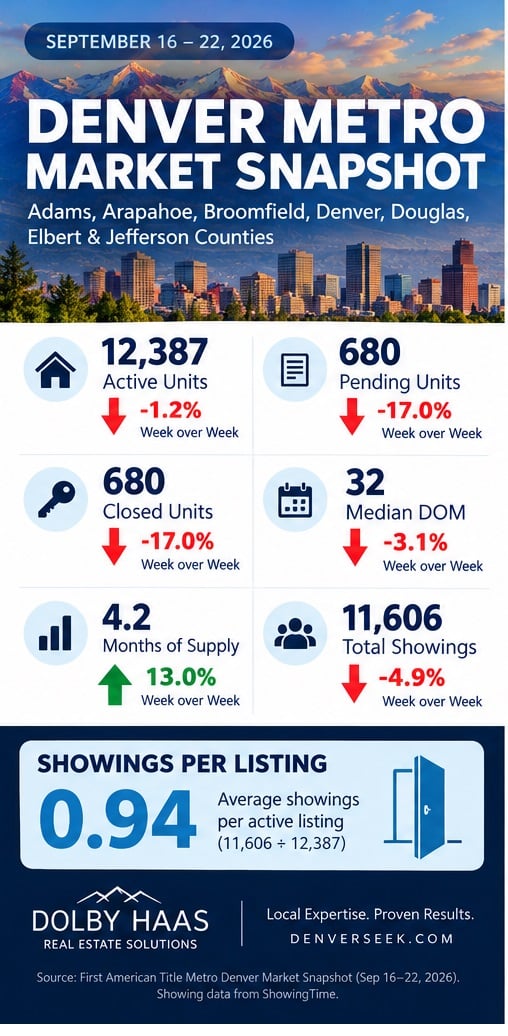
Less Than One Showing Per Listing Per Week
According to First American Title's Metro Denver Market Snapshot for September 16–22, 2026, the seven-county market recorded:
Market Indicator | Weekly Result | Change |
Active listings | 12,387 | Down 1.2% |
Pending transactions | 680 | Down 17.0% |
Median days on market | 32 | Down 3.1% |
Months of supply | 4.2 | Up 13.0% |
Total showings | 11,606 | Down 4.9% |
The number that really catches my attention is showing activity.
Divide 11,606 showings by 12,387 active listings, and you get just 0.94 showings per listing per week.
That's less than one showing per home.
Of course, those showings aren't evenly distributed. Some homes receive several appointments while others receive none.
But this is an extraordinarily quiet environment for sellers who remember the days when buyers lined up outside homes.
And it's especially challenging for properties in higher price ranges, where the pool of qualified buyers is naturally smaller.
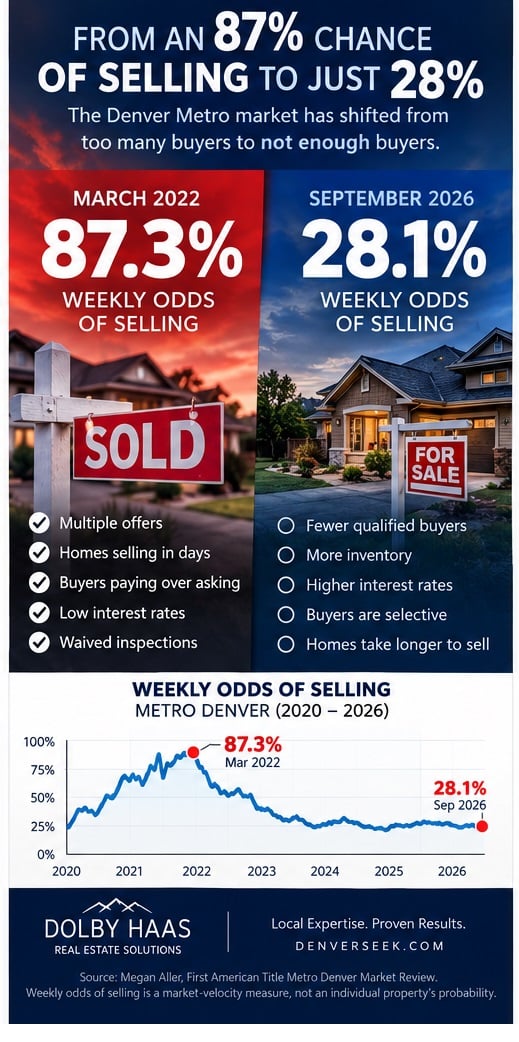
From 87% to 28%: What Changed?
Megan Aller, whose weekly Metro Denver Market Review has tracked the housing market for six years, recently published a fascinating comparison.
In March 2022, the market's weekly odds-of-selling measure reached 87.3%.
By September 2026, that measure had fallen to 28.1%.
That's a decline of nearly 60 percentage points.
These figures describe market velocity, not the literal probability that an individual home will sell. But they illustrate how dramatically the balance between buyers and sellers has changed.
During the pandemic housing boom, buyers competed for houses.
Today, houses compete for buyers.
Back then, sellers could often expect multiple offers, waived inspections, appraisal-gap guarantees, and contracts within days of listing.
Today, buyers have choices. They can negotiate. They can take their time. And if a home doesn't offer the right combination of location, condition, and price, they can simply move on.
What's behind the change?
Affordability is a major factor.
Home prices rose dramatically during the pandemic, and mortgage rates subsequently increased. That combination has made homeownership more expensive and reduced the number of buyers who can comfortably qualify.
The result isn't necessarily an overwhelming supply of homes.
It's a shortage of buyers relative to the number of homes available.
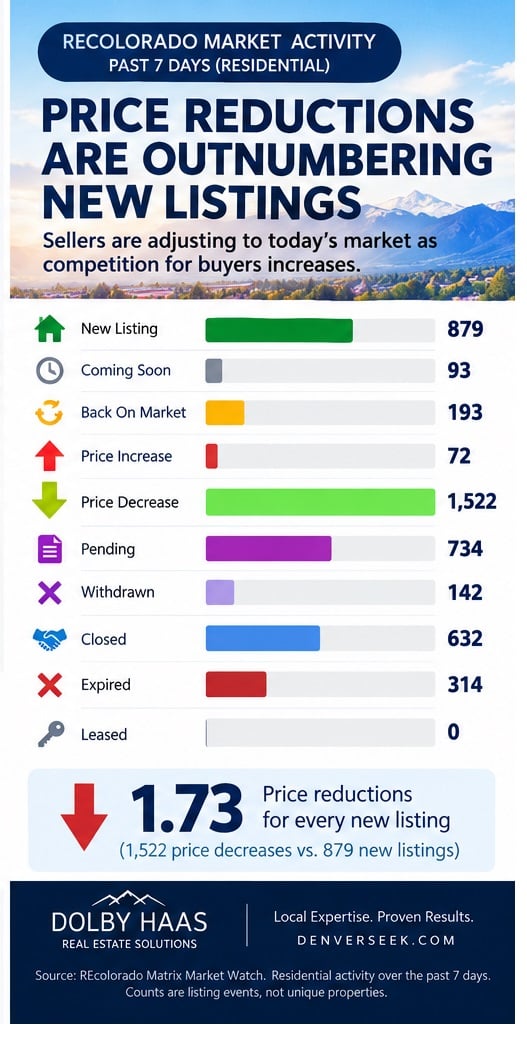
Price Reductions Are Outnumbering New Listings
Now let's look at the latest activity in REcolorado.
The residential Market Watch report for the seven days ending October 12, 2026, reveals just how aggressively sellers are responding.
REcolorado Market Activity | Past 7 Days |
New listings | 879 |
Coming soon | 93 |
Back on market | 193 |
Price increases | 72 |
Price reductions | 1,522 |
Pending | 734 |
Closed | 632 |
Withdrawn | 142 |
Expired | 314 |
The most striking comparison is between new listings and price reductions.
There were 1,522 price-reduction events compared with just 879 new listings.
That's approximately 173 price reductions for every 100 new listings.
Put another way, there were 73% more price-reduction events than new-listing events.
These are MLS activity counts, not a count of unique properties, so the comparison doesn't mean 173% of homes reduced their prices.
But it does illustrate the intensity of repricing activity.
Existing sellers are working harder to compete for a limited number of buyers.
And the evidence doesn't stop there.
More Than Half of Pending Homes Had Reduced Their Price
According to Megan Aller's September market analysis, 51.5% of homes going under contract had experienced a price reduction.
Among those reduced-price pending listings, the average adjustment was:
$53,973 — or 7.7% below the original asking price.
That's a significant concession in asking price before the property even goes under contract.
And remember, that figure measures reductions in asking prices, not the final discount from asking price to closed sale price.
For sellers, the lesson is important.
The market is telling us what buyers are willing to pay. The longer we ignore those signals, the greater the risk of spending additional weeks or months chasing the market downward.
That doesn't mean every home should immediately receive a price cut.
But it does mean that pricing decisions need to be based on current competition and buyer behavior, not on what a neighbor received in 2022.
Sellers Are Beginning to Walk Away
Another interesting development is the number of homes leaving the market without a sale.
During the same seven-day REcolorado reporting period:
That's 456 withdrawn or expired listing events in one week.
We don't know why each property left the market. Some owners may have changed plans, others may be switching brokers, and some may be preparing to relaunch later.
But the numbers demonstrate substantial movement among unsold listings.
As sellers withdraw properties, the remaining homes face less competition.
That could eventually create an opportunity for owners who choose to stay on the market, provided their homes remain competitively positioned.
It Takes More Showings to Produce a Contract
Megan's September report recorded 11,606 showings and 680 pending transactions.
That's approximately 17.1 showings for every pending transaction across the market.
It's a marketwide activity ratio, not a prediction that every property needs 17 showings to sell.
Some homes sell after one appointment. Others receive dozens of showings without an acceptable offer.
We've seen both situations.
In fact, our recent offer came after weeks of little to no showing activity.
That's why I don't believe sellers should automatically interpret a quiet week as evidence that their home cannot sell.
It only takes one buyer.
But we still need to understand why that buyer would choose your home instead of the competition.
The Internet Is Still the First Showing
Most buyers begin their search online, long before they schedule a physical appointment.
That makes online presentation especially important in a slower market.
Professional photography, thoughtful staging, accurate floor plans, compelling descriptions, and strong digital exposure help a home compete for attention.
But online activity also provides valuable feedback.
We monitor views, saves, showing requests, and competing properties to understand whether buyers are noticing a listing and whether that interest is turning into appointments.
A home receiving substantial online attention but no showings may be telling us something different from a home receiving almost no attention at all.
And a home receiving repeated showings without an offer may need a different adjustment.
Those distinctions matter.
Price is important, but price isn't the only part of the strategy.
Buyers Have More Negotiating Power Than They've Had in Years
There is another side to this market, and it's encouraging for buyers.
During the pandemic, buyers frequently had to ask themselves what protections they were willing to give up to win a home.
Today, buyers can often negotiate on price, closing costs, repairs, and financing incentives.
Seller concessions can be particularly useful.
For example, a seller-paid mortgage-rate buydown may reduce a buyer's monthly payment more effectively than an equivalent reduction in purchase price, depending on the financing terms and how long the buyer keeps the mortgage.
That's worth exploring with a knowledgeable lender.
For sellers, creative financing incentives may also be a way to attract attention without relying exclusively on a lower asking price.
The goal is to make the property more affordable and appealing to the buyer who is most likely to purchase it.
Should You Stay on the Market or Wait Until Spring?
This is the question many sellers are asking right now.
Historically, our housing market follows a recognizable seasonal pattern.
Buyers tend to become more active shortly after the holidays, with much of the strongest activity occurring during the first half of the year.
Activity often slows after July Fourth and continues to decline as we approach the holidays.
We're seeing that seasonal slowdown now, amplified by affordability challenges and cautious buyer behavior.
For some sellers, staying on the market makes sense. There are still qualified buyers searching, and fewer competing listings can create an advantage.
For others, withdrawing temporarily, refreshing the presentation, and preparing for an early-2027 relaunch may be worth considering.
The right decision depends on the property, the competition, the seller's timeline, and what the market is telling us.
The Bottom Line: A Quiet Market Is Not a Dead Market
The numbers aren't particularly encouraging for sellers.
Showings have fallen below one per listing per week. Price reductions are widespread. More than half of pending homes in the September analysis had already reduced their asking prices.
And the market's odds-of-selling measure has fallen dramatically from the extraordinary conditions of 2022.
But here's the part I don't want sellers to overlook.
REcolorado still recorded 632 closed sales and 734 pending-sale events over the past seven days.
Those are real transactions taking place in a challenging market.
We experienced it ourselves this week when a listing that had been unusually quiet finally attracted a good offer.
Buyers haven't disappeared.
They're more selective, more price-conscious, and more deliberate than they were a few years ago.
For sellers, success today requires realistic expectations, excellent presentation, competitive pricing, and a willingness to adjust when the evidence calls for it.
Sometimes patience is rewarded.
Sometimes a price adjustment is necessary.
And sometimes the smartest strategy is to step away and prepare for a stronger selling season.
The important thing is to have a plan rather than simply hope for the best.
At Dolby Haas Real Estate Solutions, we combine local market knowledge, online buyer engagement, showing activity, and competitive analysis to help sellers make those decisions.
Learn more about our approach:
https://denverseek.com/blog/how-we-maximize-your-sale-price
Stay up to date on the latest real estate trends.

Real Estate
Nov 5, 2026



Oct 27, 2026


Real Estate
How We Work

October 7 -13, 2026
From an 87% Chance of Selling to Just 28%
Dolby Haas has established a reputation for outstanding performance including several recording-breaking sales from Northern Colorado Springs, Evergreen, Greater Denver, and Broomfield. Contact him today!