Do Open Houses Really Sell Homes or Just Create Traffic?
Real Estate Grant Dolby May 30, 2026
Real Estate Grant Dolby May 30, 2026
Real Estate Grant Dolby May 30, 2026
There is a long-standing belief in real estate that if a home is not selling, the answer must be an open house. More signs. More balloons. More cookies. More traffic. The problem is that the actual data tells a more complicated story.
That does not mean open houses are useless. Some properties benefit from them. But when we look at where buyers actually find the homes they purchase, the science is pretty clear: home shopping has become an electronic process.
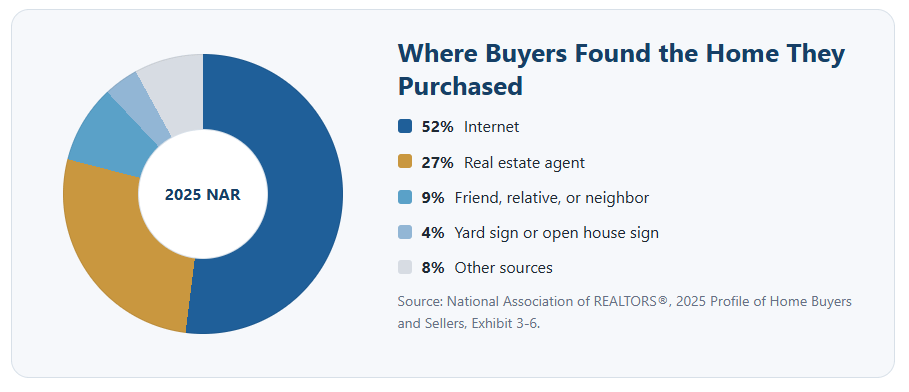
According to the National Association of REALTORS® 2025 Profile of Home Buyers and Sellers, 52% of buyers found the home they ultimately purchased through the internet. Another 27% found their home through a real estate agent. Nine percent found it through a friend, relative, or neighbor. Only 4% found the home through a yard sign or open house sign.
Put differently, nearly eight out of ten buyers found their home either online or through an agent. And in practical terms, the agent usually found it through their version of the internet: the MLS.
So the modern buyer path usually looks like this: the home appears in the MLS, syndicates to portals, shows up in saved searches, gets viewed on a phone, and then earns, or fails to earn, a private showing. The first showing often happens on a screen.
The MLS remains the professional marketplace. It is where brokers cooperate, share inventory, and distribute listing data. But consumers usually do not begin inside the MLS. They begin on the portals.
Zillow continues to command enormous consumer attention. Public traffic rankings vary depending on methodology, but Statista reported Zillow as the most visited real estate website in the U.S. in 2025 and noted that its traffic was more than double Realtor.com’s. Other portals such as Realtor.com, Homes.com, Redfin, and Trulia matter, but Zillow still functions like the main consumer shopping mall for residential real estate.
Practical translation: if the photography, pricing, remarks, floor plan, map position, and portal presentation do not create interest online, an open house is usually trying to solve the wrong problem.
NAR’s 2025 data says 48% of buyers used open houses as an information source during their search, and 43% found open houses very useful. That matters. It means open houses can help buyers evaluate a property.
But evaluation and discovery are not the same thing. The same NAR report shows that only 4% of buyers found the home they purchased from a yard sign or open house sign. That is the key distinction.
Many buyers who attend an open house already know the home exists. They saw it online, saved it, compared it to competing listings, and then decided whether it was worth seeing in person.
There is an old industry rule of thumb that many open-house visitors are not immediate buyers and may be six to eight months away from acting. I found stronger current support for the broader idea than for that exact eight-month number.
NAR’s current research says buyers spent a median of 10 weeks actively searching in 2025. That is the active search window, not the early curiosity stage. Open houses often attract people before they enter that serious 10-week window. They may be learning neighborhoods, testing price ranges, exploring layouts, or deciding whether they even want to move.
That is why open houses often generate future leads for agents, but not necessarily immediate contracts for sellers.
A well-executed open house can make sense in a dense urban neighborhood. Think Washington Park, Platt Park, Sloan’s Lake, or other areas where buyers are already nearby, multiple homes are open, and weekend traffic is part of the culture.
A rural property is a different animal. If the home is outside normal traffic patterns, outside cell coverage, or far enough away that buyers must intentionally plan the trip, the odds of a random open-house visitor becoming the buyer drop sharply.
For rural homes, acreage properties, mountain properties, and unusual homes, online presentation matters even more. Buyers are unlikely to drive an hour into the hills because they saw an arrow sign. They are more likely to drive that hour because the online presentation convinced them the property might be worth it.
Here is the part sellers rarely expect: NAR’s 2025 data says 9% of buyers found the home they purchased through a friend, relative, or neighbor. That is more than double the 4% who found it through a yard sign or open house sign.
In other words, a conversation at work, a neighbor forwarding the listing, or a friend mentioning the property can statistically matter more than a random visitor walking through an open house.
Maybe. But it depends on the property, the location, and the purpose.
If the purpose is to create convenient access, generate another portal event, give buyers a reason to act, or let a highly knowledgeable owner explain a complicated property, an open house can be useful.
If the purpose is to magically create demand where online demand is weak, that is wishful thinking dressed up as marketing.
The blunt version: open houses are not dead, but they are not the engine. The engine is online exposure, price position, photography, MLS distribution, portal performance, buyer-agent awareness, and follow-up.
The internet became the first showing. The MLS became the distribution engine. The portals became the storefronts. The open house became one tool inside a much larger system.
The sellers who understand that tend to make better decisions about where to spend time, energy, and marketing dollars.
Stay up to date on the latest real estate trends.
Denver Is Stable, But the Market Has Split in Two
Real Estate
A difficult property. A strong outcome. 98% of asking price.
Broker
Success Story
Real Estate
Buyers Gain Leverage, but Prices Are Holding
Real Estate
August 17, 2026
Dolby Haas has established a reputation for outstanding performance including several recording-breaking sales from Northern Colorado Springs, Evergreen, Greater Denver, and Broomfield. Contact him today!