On the Market or in the Hunt?
Real Estate Grant Dolby August 4, 2026
Real Estate Grant Dolby August 4, 2026
Real Estate Grant Dolby August 4, 2026
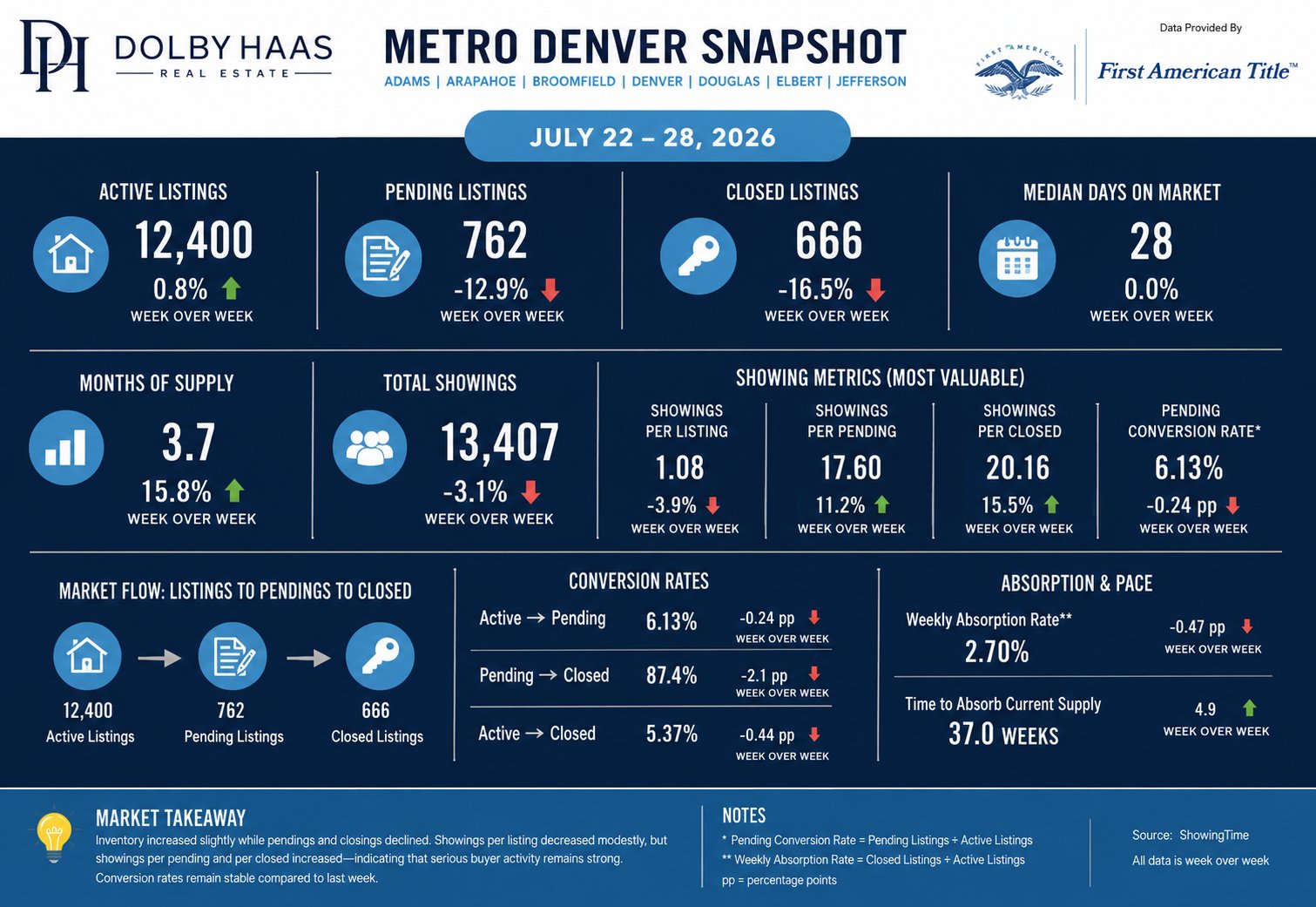
Metro Denver’s latest market snapshot for July 22–28, 2026, shows a market with plenty of inventory but weakening buyer conversion:
The headline is not simply that sales declined. It is that inventory increased while showings, pending contracts and closings all declined. Buyers have more choices and are taking advantage of them.
The Average Listing Received About One Showing
Dividing 13,407 showings among 12,400 active listings produces an average of approximately 1.08 showings per listing for the week.
That does not mean every home received one showing. Well-positioned listings may have received several, while many received none. But it gives sellers a useful benchmark:
For most sellers, one showing per week should be considered the minimum acceptable pace. The better target is two to three.
That level of activity gives a property enough exposure to generate repeat showings, buyer comparisons and, ultimately, an offer. It also gives the seller usable market feedback instead of forcing decisions based on one visitor’s opinion.
How Many Showings Does It Take to Produce a Sale?
The market recorded 13,407 showings and 762 new pending contracts during the week. That works out to roughly 18 showings for every pending transaction reported.
This is not a literal “18 showings and the home sells” formula. Showings and contracts do not occur in perfectly matched weekly cohorts. A buyer may have toured a property the previous week, returned for a second showing and written an offer several days later.
Still, the relationship is valuable. Sales require showings, and showings require a home to win the buyer’s attention before the buyer ever walks through the door.
As a practical rule, a properly positioned home will often produce meaningful interest within its first seven to ten showings. Meaningful interest may include:
If a property receives seven to ten showings without producing any of those signals, the market is usually communicating something. The issue may be price, condition, presentation, location or the alternatives buyers can purchase for the same money.
More exposure will not automatically solve a value problem.
Showings Tell Us Where the Problem Is
Showing activity helps separate a marketing problem from a conversion problem.
If a property is receiving very few showings, buyers are rejecting it online. The likely causes are price, photography, presentation, property description or weak positioning against competing listings.
If the property is receiving plenty of showings but no second visits or offers, the marketing is doing its job. Buyers are finding the home and coming through the door. They simply do not believe the value is strong enough once they compare it with the competition.
That is the uncomfortable truth sellers need to hear: winning the showing contest is not the same as winning the value contest.
What Rising Inventory Changes
At 3.7 months of supply, Metro Denver is not experiencing an extreme buyer’s market. But the 15.8% weekly increase in supply matters.
More inventory gives buyers permission to wait. They can tour several homes, revisit their favorites and negotiate more aggressively. A listing that might have received quick attention in a tighter market can now be passed over for a better-updated home, a stronger location or a more compelling price.
The median time on market remained at 28 days, but sellers should not interpret that as permission to wait four weeks before reacting. The most valuable exposure usually comes early, when the listing is new and buyer curiosity is highest.
A home that starts slowly rarely becomes more attractive simply because it has been available longer.
The Seller’s Weekly Scorecard
Every seller should review four questions each week:
The goal is not merely to remain listed. The goal is to maintain enough activity to stay in the buyer’s decision set.
In the current Metro Denver market, one showing per week keeps a property on the field. Two to three showings per week puts it in the hunt. If the showings are coming but the offers are not, the next move is usually not more patience. It is a better value proposition.
Market statistics reflect the Metro Denver market for July 22–28, 2026, including Adams, Arapahoe, Broomfield, Denver, Douglas, Elbert and Jefferson counties. Showing activity is sourced from ShowingTime.
Stay up to date on the latest real estate trends.

August 12–18, 2026


Broker
What Metro Denver Sellers Need to Know


Real Estate
Housing Market

Real Estate
AI helps us work faster. Experience helps us know what matters

Real Estate
The Story of 2237 Rim Ridge Drive


Dolby Haas has established a reputation for outstanding performance including several recording-breaking sales from Northern Colorado Springs, Evergreen, Greater Denver, and Broomfield. Contact him today!